|

|
|
COLUMBUS TO CALYPSO AND CHUTNEY
Ever since Christopher Columbus landed in Trinidad in 1498, the Caribbean island and its twin Tobago have gone through considerable social and demographic
churning. And after 500 years the results are astounding
|
|
|
Trinidad’s recorded history begins with the island’s discovery by Christopher Columbus on July 31, 1498; however, its unwritten history goes back much further—as far back as 7,000 years or more judging from archaeological artifact.
Columbus sighted the island he called La Trinidad in honour of the Blessed Trinity. Though the debate as to whether Trinidad was populated by both Arawaks and Caribs continues, Dr. Eric Williams in his book History of the People of Trinidad and Tobago claimed that, “As far as Trinidad is concerned there would appear to have been several distinct tribes of Amerindians present in the island towards the end of the 15th century. The Caribs tended to settle for the most part in the North and West, around what is today Port of Spain; two of their principal settlements were located in Arima and
Mucurapo. The Arawaks seem to have concentrated above all in the South East, and it is recorded that on occasion the Arawaks took Tobago from the
Caribs.”
|
|
Trinidad’s recorded history begins with the island’s discovery by Chistropher Columbus on July 31, 1498 |
|
Tobago may have been sighted by Columbus in 1498, but it is certain that he never landed there. It was not until 1588 that some English sailors landed in Tobago. Subsequently the Cour landers, The French and the Caribs competed for settlement there. By 1684 all races decided to cohabit.
The inhabitants of T and T in pre-Colombian times were Amerindian tribes from the South American mainland. The main group, the Arawaks, was a peaceful tribe from the upper regions of the Orinoco, in Guyana. The northern part of the island was inhabited by a fiercer tribe called the Caribs. A warlike people, the Caribs had come originally from the Amazon region, settling the islands of Tobago, St. Vincent, Dominica, Martinique and Guadeloupe. The Caribs fought fiercely against the European attempts to colonise the island; but it was, ultimately, a losing battle. War, enslavement and diseases brought to the island by the outsiders took their toll, eventually wiping out the Amerindian population almost completely.
True colonisation of Trinidad did not begin until the end of the 18th century, when the Spanish King, acting on the advice of a French planter named Roume de St. Laurent, issued the historic Cedula of Population, designed to attract immigrants to the island. The terms of the Cedula, proclaimed in 1783, offered free grants of land to citizens of any land friendly to Spain, provided that they were Roman Catholic. This meant most of the new settlers were French, since England, Spain’s other ally at the time, was mostly Protestant.
|
|
"The first batch of indentured labourers
from India arrived on the
Fatel Rozack on May 30, 1845"
|
Almost overnight, Trinidad was transformed into a colonised island, with French planters and free persons of colour flocking from the neighbouring islands. The population leapt from 2,700 inhabitants in 1783, to 17,700 in 1789—10,000 of them African slaves, imported in large numbers because the Cedula allowed extra grants of land for each slave owned. French, or a French-based patois that exists to this day, soon became the main language spoken.
In 1797, the British—no longer allies—attacked Trinidad and the Spanish, greatly outnumbered, offered little resistance. Trinidad became a British colony, and remained one until its independence in 1962.
The 1830s represented a major water shed in Trinidad’s history. The British Parliament passed an Act abolishing slavery, effective August 1, 1834—much to the dismay of the planters, whose vast sugar and cocoa estates depended on copious cheap
labour. But there remained a period of apprenticeship during which the island’s Council of Government appointed an Agent for Immigration-someone responsible for identifying alternative sources of field
labour. Various ethnic groups were tried: Portuguese-free Africans from Africa and America,
Madeirans, all with scant success.
Finally, the planters turned to Asia. The first batch of indentured labourers from India arrived aboard the Fatel Rozack on May 30,1845; they numbered a mere 213. By 1848, their numbers had swelled to more than 5,000. These workers proved satisfactory; and by the time the Indian Government finally banned emigration to Trinidad in 1917, the number of indentured workers had risen to more than 145,000. Today, East Indians constitute about 40 per cent of the total population, almost exactly the same as Africans.
Another group that found their way to Trinidad during these years was the Chinese, who were brought in between 1848 and 1852, a period during which there was a temporary halt in Indian immigration. In 1889, the Colonial Office decided to annex Tobago to its larger
neighbour. This was the beginning of the unitary state of Trinidad and Tobago. It was not until 1925 that the first, extremely restricted, election was held. In 1958, the United Kingdom tried to establish an independent Federation of the West Indies comprising most of the former British West Indies. But disagreement over the structure of the federation led to its collapse.
Trinidad and Tobago achieved full independence in 1962 and joined the British Commonwealth. Ever since the march of progress has been swift and telling. And today the results are astounding.
|
|
|

|
|
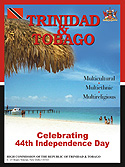
Trinidad & Tobago
|
|
Celebrating 44th Independence Day
|
|
|
|
|
|