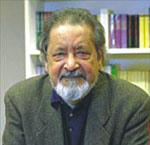
Writing has come easy to Sir V.S. Naipul, knighted by Queen Elizabeth in 1990. With is pen he has traversed many cultures and civilizations, even the unraveling of the British Empire and the migrations of people. He has written from his heart, but used his mind to great effect. He was awarded the Booker Prize in 1971, T.S. Eliot Prize for Creative Writing in 1986, Nobel Prize in 2001, making it a resplendent array of feathers in one cap.
Born in 1932 in Chaguanas near Port of Spain in Trinidad, Sir V.S. Naipul these days cultivates the quiet air of a reclusive squire living down a quiet Wiltshire lane. His grandparents had left for T and T from India to work in the sugar plantations. His father a newspaper reporter and aspiring fiction writer was the model for what is arguably Sir Vidiadhar’s most outstanding novel, A House for Mr. Biswas (1961).
At the age of 18, Sir Vidiadhar left Trinidad on a scholarship to University College, Oxford, and has lived in England since. In 1953, he was awarded a Bachelor of Arts. From then on he spent a great deal of time traveling in Asia, Africa, America. Apart from a few years in the middle of the 1950s when he was employed by the British Broadcasting Corporation as a free-lance journalist, he has devoted himself entirely to his writing. The events of his earliest books take place in the West Indies.
| He was awarded the Booker Prize in 1971, T.S. Eliot Prize for Creative Writing in 1986, Nobel Prize in 2001, making it a resplendent array of feathers in one cap |
After the enormous success of A House for Mr. Biswas, Sir Vidiadhar extended the geographical and social perspective of his writing to describe the impact of colonialism and emerging nationalism on the third world in, for instance, Guerrillas (1975) and A Bend in the River (1979), the latter a portrayal of Africa that has been compared to Conrad’s Heart of Darkness. The Mystic Masseur had come earlier in 1957.
Sir Vidiadhar has written that, “Everything of value to me is in my books. I will go further now. I will say I am the sum of my books. Each book, intuitively sensed and, in the case of fiction, intuitively worked out, stands on what has gone before, and grows out of it. I feel that at any stage of my literary career it could have been said that the last book contained all the others.”
He describes the place of his birth as follows: “I was born in a small country town called Chaguanas. It was a strange name, in spelling and pronunciation, and many of the Indian people—they were in majority in the area—preferred to call it Chauhan.”
Interesting details from a knight with a shining pen.
|