

Trinidad Eyes Indian Trade
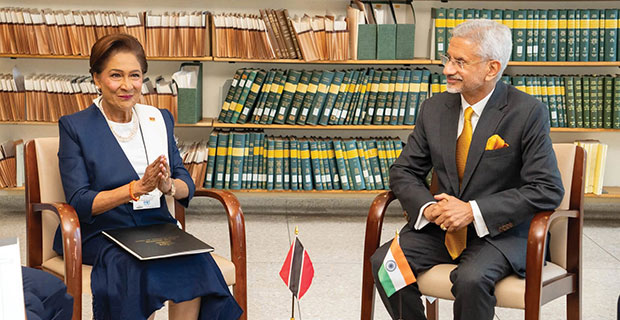
United Nations: Trinidad and Tobago Prime Minister Kamla Persad-Bissessar discussed economic cooperation, increased trade and Exim Bank financing for development projects with External Affairs Minister (EAM) S Jaishankar during their meeting in New York on September 22, on the sidelines of the 81st session of the United Nations General Assembly.
Following the meeting, Ms Persad-Bissessar said the two sides had discussed strengthening Trinidad and Tobago-India relations through greater economic cooperation, increased trade and Exim Bank financing for development projects. “Our longstanding friendship continues to grow,” she said.
EAM Jaishankar, who said he was privileged to meet the Prime Minister, said the two sides had reviewed progress on commitments made during Prime Minister Narendra Modi’s visit to Trinidad and Tobago in July 2025. These included the supply of laptops, provision of artificial limbs, revival of academic chairs, solarisation and Quick Impact Projects.
During Prime Minister Modi’s visit, India offered 2,000 laptops for Trinidad and Tobago’s flagship educational programmes, supported the revival of academic chairs in Hindi and Indian studies at the University of the West Indies, and agreed to provide artificial limbs for 800 people.
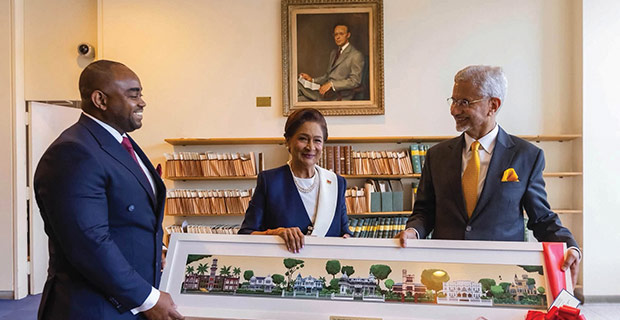
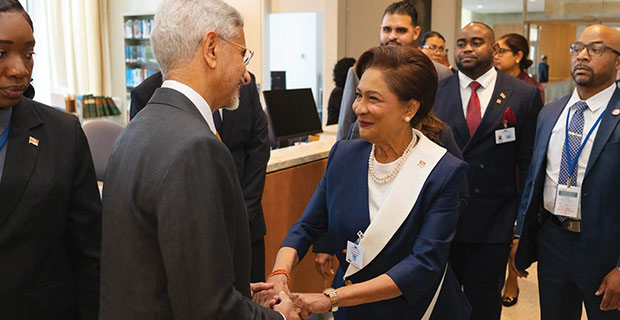
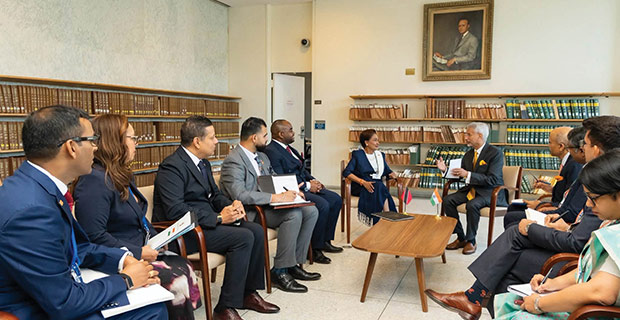
External Affairs Minister Dr S Jaishankar interacts with officials and representatives during his visit to Trinidad and Tobago in May 2026, as India and the Caribbean nation expand cooperation across several sectors.
India and Trinidad and Tobago also signed a memorandum of agreement on Quick Impact Projects (QIPs), under which New Delhi is to provide US$50,000 for five projects each year. Another agreement provided for India to install a solar photovoltaic system at the Ministry of Foreign Affairs.
Trinidad and Tobago has about 575,000 people of Indian descent, representing approximately 42 per cent of the Caribbean nation’s population. Prime Minister Modi’s July 2025 visit coincided with Trinidad and Tobago’s observance of the 180th anniversary of the arrival of Indian immigrants in the country in 1845.
The diaspora remains an important dimension of the relationship, while recent exchanges have expanded the bilateral agenda into areas including healthcare, education, infrastructure, renewable energy, tourism and traditional medicine.
Earlier in 2026, India and Trinidad and Tobago signed eight agreements during EAM Jaishankar’s two-day visit to the Caribbean nation in May. The agreements covered tourism, healthcare, infrastructure, solar energy and Ayurveda, among other areas.
The two sides agreed to solarise the building housing Trinidad and Tobago’s Ministry of Foreign and CARICOM Affairs and to cooperate on vector control. They also agreed on an infrastructure upgrade for Nelson Island, where Indian immigrants were initially housed, and on establishing an Indian Chair on Ayurveda at the University of the West Indies.
Jaishankar’s May visit also saw the launch of a permanent National Prosthetics Centre in Trinidad and Tobago, reflecting another strand of India’s development and healthcare cooperation with the Caribbean nation.
From laptops and prosthetic limbs to solar energy, infrastructure and Ayurveda, India’s development partnership is reaching across Trinidad and Tobago.
The September meeting in New York therefore came against the backdrop of an expanding programme of bilateral cooperation. Economic engagement is now an important part of that agenda, with trade, investment and development financing adding to longstanding cultural and people-to-people connections.
For Trinidad and Tobago, stronger commercial links with India offer opportunities to access Indian expertise, technology and financing across a range of sectors. For India, the Caribbean nation provides an important partner in a region where historical links with the Indian diaspora continue to underpin contemporary economic and diplomatic engagement.
The latest discussions also demonstrate how the relationship is evolving beyond its historical foundations. With cooperation now spanning education, healthcare, renewable energy, infrastructure, tourism, agriculture and Ayurveda, the economic dimension is increasingly becoming part of the wider India-Trinidad and Tobago partnership.
Related News.
-

November 2026 “We Need to Bridge the Gap”
-

November 2026 “Business Needs Cultural Connection”
-

November 2026 REPORT URGES DURABLE TIES
-

November 2026 ENVOYS DISCUSS PANAMA TIES
India Empire TV

EDITOR'S DESK, Nov 2026
 A relationship between nations is rarely built on a single summit, agreement or trade figure. It takes shape over generations: through the movement of people, the exchange of ideas, the trust created by diplomacy and the practical partnerships that improve lives. This November issue of India Empire explores that wider canvas of India’s engagement with the world...
more...
Ads Spot

Comments.