

“We Need to Bridge the Gap”
In an interview with Sayantan Chakravarty, Editor-in-Chief and Publisher of India Empire, H.E. Mr Chandradath Singh, High Commissioner of Trinidad and Tobago to India, reflects on the historic bonds between the two countries, the legacy of Indian indentured labourers and the distinct identity of the Caribbean’s plantation diaspora. He discusses opportunities for trade, joint ventures, filmmaking and tourism, the importance of recognising the Kolkata memorial as a heritage site, and the enduring connections forged through cricket, music and culture. He also calls for stronger educational cooperation as both countries prepare for an AI-driven future.
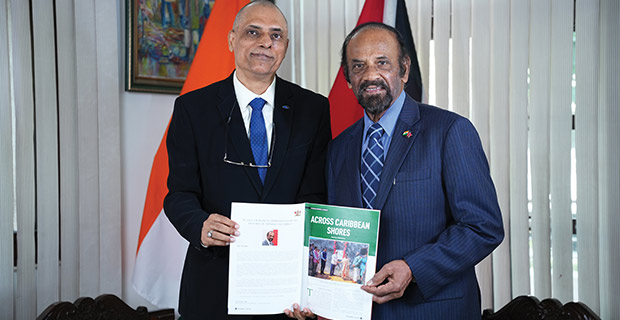
Excellency, this is your third posting in India as Head of Mission. You first came in 1988, returned in 2011 and assumed your present posting in December 2025. What makes India such a familiar and important destination for you?
I know India well. I first came here as a Commonwealth scholarship student and subsequently served in different capacities. I have travelled extensively across the country and understand its people, culture and institutions. That experience enables me to function effectively from the beginning of a posting.
I also have a personal connection with India. I studied history, international law and diplomacy here, and my association with the country goes beyond professional responsibilities. I met my wife, Mrs Anita Chandraj Singh, when she was a presenter with Doordarshan. She interviewed me for the programme Youth Forum after learning about my interest in music and the steelpan, our national instrument. That encounter eventually brought us together.
It is a pleasure to return at a time when relations between India and Trinidad and Tobago are expanding. I hope to encourage greater interaction between our countries and the wider Indian diaspora.
The people-to-people relationship dates back to May 30, 1845, when the Fatel Razack arrived in Trinidad with Indian indentured labourers. What does this history mean for Trinidad and Tobago today?
It is a tremendously important part of our history. The arrival of the Fatel Razack began a relationship that has continued for more than 180 years. Our ancestors came principally from Bihar and Uttar Pradesh, and their experience transformed Trinidad and Tobago.
The indentured workers faced difficult circumstances and had to adapt to a new environment. They used what was available to develop distinctive forms of cuisine, music and cultural expression. Our society evolved into a unique blend of Indian heritage and the traditions of other communities.
Trinidad and Tobago is a multi-ethnic, multicultural country. Our Indian heritage remains a significant part of that identity, but the experience of the Caribbean diaspora is different from that of Indians who migrated to other parts of the world.
We were separated from India for generations. Many ancestors left believing they would eventually return, but they never did. The emotional desire to reconnect with their ancestral homeland remains powerful among their descendants.
Related News.
-

November 2026 Trinidad Eyes Indian Trade
-

November 2026 “Business Needs Cultural Connection”
-

November 2026 REPORT URGES DURABLE TIES
-

November 2026 ENVOYS DISCUSS PANAMA TIES
India Empire TV


EDITOR'S DESK, Nov 2026
 A relationship between nations is rarely built on a single summit, agreement or trade figure. It takes shape over generations: through the movement of people, the exchange of ideas, the trust created by diplomacy and the practical partnerships that improve lives. This November issue of India Empire explores that wider canvas of India’s engagement with the world...
more...
Ads Spot

Comments.