

BANGKOK TALKS BUSINESS
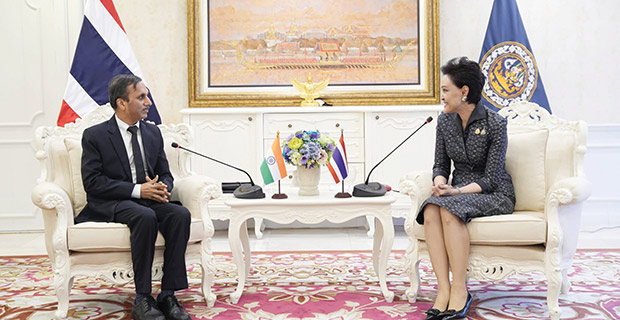
Bangkok: India and Thailand are looking to widen the commercial scope of their relationship, with discussions focusing on trade and investment, areas of complementarity, tariff and non-tariff barriers and the need for a more balanced trading relationship. The issues were discussed when Ambassador of India to Thailand, Mr Puneet Agrawal, called on H.E. Mrs Suphajee Suthumpun, Deputy Prime Minister and Minister of Commerce of Thailand, on September 17.
The Indian Embassy in Thailand said the two sides exchanged views on furthering trade and investment ties by identifying areas where their economies complement each other, addressing tariff and non-tariff barriers and working towards balanced trade for mutual benefit. The conversation came amid a series of high-level engagements between India and Thailand covering a broad range of economic sectors and wider bilateral cooperation.
The latest meeting followed discussions on September 9 between Union Minister of Commerce and Industry Mr Piyush Goyal and a Thai delegation led by Deputy Prime Minister Mrs Suthumpun. The meeting examined ways to expand economic engagement across trade, investment, tourism, logistics, pharmaceuticals, food processing, clean energy, automobiles and space. Mr Goyal subsequently said the discussions were aimed at creating greater opportunities for businesses and people in both countries.
The breadth of sectors under discussion reflects the increasingly varied character of India-Thailand economic relations. Alongside established commercial areas such as trade and investment, the two countries are looking at newer fields including clean energy, space and advanced manufacturing, while tourism, logistics, pharmaceuticals and food processing offer additional avenues for commercial interaction.
Thailand’s participation in the 18th BRICS Summit in New Delhi on September 12-13 provided another occasion for senior-level engagement. Deputy Prime Minister Mr Sihasak Phuangketkeow visited India to attend the summit, adding to the series of high-level contacts between the two countries during September.
“Discussed ways to further strengthen India–Thailand economic relations and deepen cooperation across trade, investment, tourism, logistics, pharmaceuticals, food processing, clean energy, automobiles, and space.”
The economic discussions have taken place alongside broader diplomatic engagement. On September 7, Ambassador Puneet Agrawal called on Thailand’s Vice Minister for Foreign Affairs Vijavat Isarabhakdi, with discussions covering the bilateral strategic partnership, including trade and investment, defence and security and cultural exchanges. The sequence of meetings has brought economic and diplomatic priorities into a common conversation as the two countries look at the next phase of their relationship.
India and Thailand established diplomatic relations in 1947, and the two countries marked the 75th anniversary of their diplomatic ties in 2022. According to the Indian Embassy in Thailand, the relationship encompasses trade and investment, defence and security, connectivity, culture and tourism, education, science and technology, and people-to-people exchanges.
Geography and regional policy add another dimension to the partnership. Thailand’s ‘Act West’ policy complements India’s ‘Act East’ policy, while Thailand’s position as India’s maritime neighbour gives the relationship an important connectivity and regional dimension. The two countries therefore share interests that extend beyond bilateral commerce into wider questions of movement, logistics and regional economic engagement.
The immediate commercial agenda, however, remains firmly focused on practical issues. Identifying areas of complementarity could allow businesses in both countries to build on sectors where their respective capabilities and market requirements intersect. At the same time, resolving tariff and non-tariff barriers remains important for improving market access and facilitating trade flows.
The emphasis on balanced trade also places the commercial relationship within a broader framework of mutual benefit. Rather than focusing solely on expanding the volume of trade, the discussions have addressed the composition and conditions of that trade, with both sides examining how greater market access and sectoral cooperation can create opportunities for businesses on either side.
Related News.
-

October 2026 A NEW CHAPTER
-

October 2026 “We Can Be A Gateway”
-

October 2026 “Come And See Ecuador”
-
October 2026 Confidence Across Continents
India Empire TV


EDITOR'S DESK, Oct 2026
 The October 2026 issue of India Empire explores a world in which diplomacy, commerce, innovation and human connections increasingly shape one another. Across our stories, a recurring theme emerges: relationships acquire lasting value when goodwill is translated into practical outcomes...
more...
Ads Spot

Comments.