

Across Strategic Steppes
India’s engagements at the Shanghai Cooperation Organisation Foreign Ministers’ Meeting reaffirmed New Delhi’s growing commitment to Central Asia, where bilateral partnerships are steadily acquiring greater strategic depth even as regional institutions evolve to address an increasingly complex geopolitical landscape.
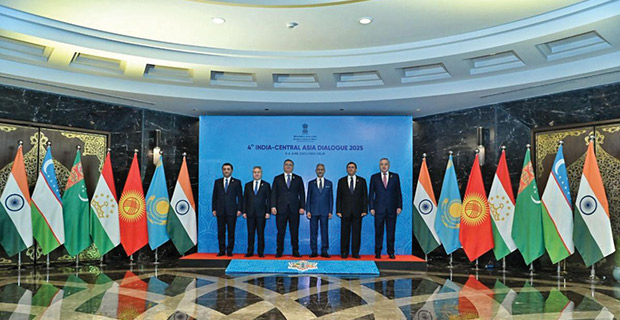
Diplomacy often unfolds most effectively away from the glare of ceremonial state visits. Multilateral gatherings, where ministers move seamlessly between formal sessions and bilateral consultations, provide fertile ground for advancing relationships that might otherwise remain confined to protocol. It is in these quieter diplomatic settings that trust is reinforced, common priorities are refined and regional partnerships acquire fresh momentum. India’s participation in the Shanghai Cooperation Organisation (SCO) Foreign Ministers’ Meeting in Kyrgyzstan offered precisely such an opportunity, underscoring New Delhi’s steadily expanding engagement with Central Asia.
Representing India at the ministerial gathering, Union Minister of State for External Affairs Kirti Vardhan Singh embarked upon a series of bilateral discussions that reflected the country’s sustained commitment to strengthening ties with partners across the Eurasian region. While the official agenda of the SCO focused on preparations for the forthcoming Leaders’ Summit and deliberations on regional and international developments, the meetings on the sidelines demonstrated that India’s Central Asian outreach has evolved well beyond participation in multilateral forums. It is increasingly being shaped by carefully cultivated bilateral relationships built upon shared strategic interests and mutual confidence.
Among the most significant engagements was Mr Singh’s meeting with Belarusian Foreign Minister Maxim Ryzhenkov. The interaction reviewed the progress of bilateral cooperation while providing an opportunity to exchange views on regional and global developments that increasingly influence the broader Eurasian landscape. Although India and Belarus have maintained cordial relations for decades, the conversation reflected a shared determination to broaden cooperation into areas capable of supporting long-term strategic engagement. In reaffirming their commitment to strengthening bilateral ties, both ministers recognised that the changing international environment demands partnerships characterised by continuity, dialogue and practical collaboration rather than episodic interaction.
Equally important were Mr Singh’s discussions with Kyrgyzstan’s Foreign Minister Zheenbek Kulubaev, which highlighted the growing maturity of the India-Kyrgyz Republic Strategic Partnership. The two ministers reviewed progress across key sectors while exploring new opportunities for cooperation that reflect the expanding scope of bilateral relations. Once viewed primarily through the prism of historical and cultural links stretching back to the ancient Silk Routes, India-Kyrgyzstan relations are today increasingly defined by practical cooperation in areas aligned with contemporary developmental priorities.
The symbolism of these meetings extends beyond the individual relationships themselves. Central Asia occupies an increasingly important position within India’s foreign policy, not merely because of its geographical proximity to South Asia but because of its growing relevance to questions of connectivity, energy security, regional stability and economic integration. As global supply chains evolve and Eurasia acquires renewed strategic significance, India’s engagement with Central Asian republics has become an essential component of its wider continental diplomacy.
The Shanghai Cooperation Organisation naturally provides an important institutional framework for advancing those objectives. Established to promote regional cooperation across political, economic and security dimensions, the organisation has steadily expanded its agenda to encompass issues ranging from counter-terrorism and connectivity to sustainable development and regional prosperity. For India, active participation within the SCO reflects both its commitment to multilateral diplomacy and its recognition that many contemporary challenges transcend national borders and demand cooperative solutions.
Preparations for the forthcoming SCO Leadership Summit in Bishkek also featured prominently during the ministerial deliberations. Foreign ministers reviewed progress across multiple areas of cooperation while finalising documents expected to be placed before Heads of State later this year. Kyrgyzstan’s presidency theme, ‘25 Years of the SCO: Together Towards Sustainable Peace, Development and Prosperity’, captures the organisation’s aspiration to balance regional security with broader developmental cooperation, a philosophy that resonates with India’s own emphasis on inclusive and sustainable growth.
Related News.
-

August 2026 A TYPHOON HITS TOURISM
-

August 2026 A PLACE OF RETURN
-

August 2026 The Modi Method
-

August 2026 Trade Momentum Accelerates

EDITOR'S DESK, Aug 2026
 Some conversations acquire a life beyond the interview itself.My conversation with Shri Gajendra Singh Shekhawat, Union Minister for Culture and Tourism, is the Cover Story of this issue. What began with the preservation of India’s civilisational heritage and the restitution of antiquities moved naturally through manuscripts, artificial intelligence, cultural mapping, tourism and UNESCO recognition...
more...
Some conversations acquire a life beyond the interview itself.My conversation with Shri Gajendra Singh Shekhawat, Union Minister for Culture and Tourism, is the Cover Story of this issue. What began with the preservation of India’s civilisational heritage and the restitution of antiquities moved naturally through manuscripts, artificial intelligence, cultural mapping, tourism and UNESCO recognition...
more...
Ads Spot

Comments.