

Beyond Shared Horizons
What began as a relationship anchored in ancestry and history is today emerging as one of the Global South’s most compelling examples of strategic partnership, with India and Mauritius crafting a model that seamlessly blends culture, commerce, security and shared prosperity.
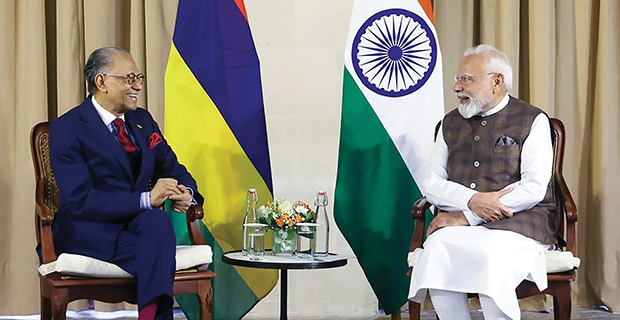
There are diplomatic relationships that are forged by geography, others by economics, and still others by geopolitical necessity. Then there are relationships like that between India and Mauritius, shaped over generations by shared memory, migration, language and culture, yet constantly reinventing themselves to address the demands of a changing world. Today, this enduring partnership is acquiring a new vocabulary, one that speaks of maritime security, infrastructure, technology, investment, healthcare and regional leadership, without ever losing sight of the emotional ties that first brought the two nations together.
Few countries illustrate India’s contemporary foreign policy as naturally as Mauritius. Located in the heart of the Indian Ocean yet deeply connected to India’s civilisational story, the island nation has become an increasingly important pillar of New Delhi’s vision for the region. The evolution has been particularly visible under Prime Minister Narendra Modi’s leadership, during which successive initiatives have elevated bilateral engagement from traditional development cooperation to a comprehensive strategic partnership encompassing virtually every sector of national development.
Mauritius Foreign Minister Dhananjay Ramful, in an extensive interaction with IANS, offered perhaps the clearest articulation of this transformation. Speaking with evident conviction, he described Mauritius as having remained at the centre of India’s diplomatic priorities during Prime Minister Modi’s tenure, pointing to two defining milestones that have shaped regional thinking: the launch of the SAGAR vision during Mr Modi’s 2015 visit and the unveiling of the MAHASAGAR initiative a decade later. Together, these frameworks have broadened India’s engagement with the Indian Ocean from a traditional security perspective to one encompassing holistic regional growth and shared prosperity.
The changing character of the partnership is perhaps most visible in the scale of India’s developmental footprint across Mauritius. Hospitals, transport systems, judicial infrastructure, educational institutions and aviation facilities increasingly bear testimony to sustained Indian cooperation. The Metro Express, the Supreme Court Building, the ENT Hospital, the Atal Bihari Vajpayee Institute and several other landmark projects have become tangible symbols of a partnership that extends well beyond diplomatic declarations into the daily lives of Mauritian citizens.
The announcement of a Special Economic Package valued at approximately US$680 million, comprising grants and concessional lines of credit, has further reinforced that trajectory. The package supports a broad portfolio of projects including a new national hospital, an AYUSH Centre of Excellence, a veterinary school, an animal hospital, aviation infrastructure, road development and other strategic public works. Rather than isolated investments, these initiatives collectively reflect India’s long-term confidence in Mauritius as a trusted regional partner.
Yet, reducing India-Mauritius relations to infrastructure alone would overlook the deeper architecture that underpins the partnership. Economic engagement has expanded steadily through the Comprehensive Economic Cooperation and Partnership Agreement (CECPA), which has provided renewed momentum to bilateral trade and investment. Trade between the two countries has approached US$887 million, while Mauritius continues to rank among the largest sources of foreign direct investment into India, highlighting the remarkable confidence that businesses on both sides place in one another’s economies.
For New Delhi, however, the relationship extends beyond commerce. Mauritius increasingly occupies an important place within India’s wider engagement with the Global South, where development partnerships are expected to deliver tangible benefits while respecting national priorities. Ramful described the India-Mauritius relationship as a blueprint for other developing nations, arguing that cooperation in maritime security, healthcare, technology, transport infrastructure and capacity building demonstrates how countries with shared historical experiences can construct modern partnerships rooted in mutual respect rather than dependency.
Maritime cooperation has naturally emerged as one of the defining pillars of this relationship. With both nations sharing responsibility for the stability of the Indian Ocean, collaboration has steadily deepened through information-sharing arrangements, naval exercises and the broader MAHASAGAR framework. The emphasis is not merely on safeguarding sea lanes but on ensuring that the Indian Ocean remains secure, open and governed by international law, an objective that carries increasing significance as strategic competition intensifies across the Indo-Pacific.
Equally enduring is the cultural foundation upon which this strategic partnership rests. More than two centuries after Indian indentured labourers first arrived on Mauritian shores, their descendants continue to preserve languages, traditions and festivals that remain unmistakably Indian while enriching the multicultural fabric of Mauritius. Bhojpuri continues to resonate across communities, institutions such as the Mahatma Gandhi Institute sustain cultural exchanges, and initiatives like the extension of Overseas Citizen of India cards to later generations reinforce emotional links that transcend geography. Cultural diplomacy, in this context, is not an ornamental aspect of bilateral ties but one of its strongest pillars.
Prime Minister Modi’s popularity within Mauritius also reflects this unique blend of strategic cooperation and emotional affinity. His visits have attracted exceptional public warmth, while the conferment of Mauritius’ highest civilian honour symbolised not merely appreciation for an individual leader but recognition of the remarkable expansion in bilateral engagement witnessed over the past decade. The symbolism was unmistakable: diplomacy succeeds most meaningfully when governments and peoples move together.
As the geopolitical landscape continues to evolve, the India-Mauritius relationship offers an instructive lesson in twenty-first century diplomacy. It demonstrates that enduring partnerships are rarely sustained by economics or security alone. They flourish when strategic interests are reinforced by historical trust, when development is accompanied by cultural understanding, and when shared aspirations are allowed to evolve naturally across generations. In that sense, the waters of the Indian Ocean are no longer merely a geographical bridge between India and Mauritius. They have become the stage upon which one of the Global South’s most confident and comprehensive partnerships continues to unfold.
Related News.
-

August 2026 A TYPHOON HITS TOURISM
-

August 2026 A PLACE OF RETURN
-

August 2026 The Modi Method
-

August 2026 Trade Momentum Accelerates
EDITOR'S DESK, Aug 2026
 Some conversations acquire a life beyond the interview itself.My conversation with Shri Gajendra Singh Shekhawat, Union Minister for Culture and Tourism, is the Cover Story of this issue. What began with the preservation of India’s civilisational heritage and the restitution of antiquities moved naturally through manuscripts, artificial intelligence, cultural mapping, tourism and UNESCO recognition...
more...
Some conversations acquire a life beyond the interview itself.My conversation with Shri Gajendra Singh Shekhawat, Union Minister for Culture and Tourism, is the Cover Story of this issue. What began with the preservation of India’s civilisational heritage and the restitution of antiquities moved naturally through manuscripts, artificial intelligence, cultural mapping, tourism and UNESCO recognition...
more...
Ads Spot

Comments.