

BITTER-SWEET
Jaya Bachchan and Priyanka Gandhi Vadra, standing together at an Opposition protest, offer a striking reminder of how India’s political friendships can travel from intimacy to estrangement and, decades later, find an unexpected point of convergence.
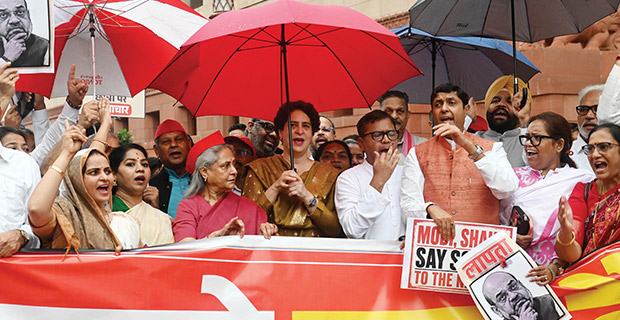
Picture by Sipra Das
There is an arresting quality to the photograph of Jaya Bachchan and Priyanka Gandhi Vadra standing next to each other at an Opposition protest. The two women come from families whose histories were once woven remarkably closely together, yet they now belong to different political formations. Jaya is one of the Samajwadi Party’s most recognisable parliamentary voices, while Priyanka Gandhi is part of the Nehru-Gandhi family that remains at the heart of the Congress. On this particular day, however, party lines temporarily yielded to a larger Opposition cause, bringing together two women whose family histories carry far more emotional baggage than the photograph reveals.
The Bachchan-Gandhi association goes back to Allahabad and Anand Bhawan, where Harivansh Rai Bachchan and Teji Bachchan entered the orbit of Jawaharlal Nehru and Indira Gandhi. Teji and Indira became close friends, and that relationship extended into the next generation. Amitabh Bachchan and Rajiv Gandhi grew up together, their friendship became one of the most familiar examples of the extraordinary social and political world inhabited by India’s most influential families. When Rajiv entered politics, Amitabh eventually followed him, winning the Allahabad Lok Sabha seat in 1984 with an enormous majority. For a period, the relationship between the two families seemed to transcend the ordinary boundaries between politics, friendship and public life.
Then politics intervened with a force that friendship could not withstand. The Bofors controversy brought Amitabh under intense scrutiny, and his decision to resign from Parliament in 1987 marked a turning point. The old intimacy between the families began to fray, and by the late 1990s the distance had become much more pronounced. Amitabh’s own fortunes had meanwhile collapsed dramatically with the failure of Amitabh Bachchan Corporation Limited. ABCL was buried under debt and legal battles, and the Bachchan family was facing one of the most difficult periods of its life. The expectation of support from old family friends collided with what Amitabh perceived as abandonment.
Out of that bitterness came one of the most memorable lines in the Bachchan-Gandhi saga: “Woh Raja hain aur hum Runk hai. Humari unse kya barabari?” The words carried a deceptively simple contrast between kings and commoners, but their political meaning was unmistakable. Amitabh was drawing a line between the family that had once been close to his own and the world in which he now found himself struggling to survive. The remark became an epitaph for a friendship that had once seemed almost indestructible.
The aftermath altered the Bachchan family’s political trajectory. Amar Singh emerged as an important source of support during Amitabh’s financial and professional crisis, and the family gravitated towards the Samajwadi Party, taking it into a political camp very different from the Congress world with which it had once been so closely associated. Jaya Bachchan eventually became an important Samajwadi Party parliamentarian and, years later, would herself speak publicly about the feeling that those who had brought the Bachchans into politics had left them midway. The old friendship had not merely faded; it had acquired a political history of its own.
Which brings us back to Jaya and Priyanka, standing together now. There is a generation hidden inside that photograph. One can imagine Priyanka growing up with the Bachchans as familiar figures rather than political opponents, with Jaya occupying that older generation of family friends whom a child might naturally have known as “Aunty”. The emotional geography of childhood is rarely mapped according to future party affiliations. The people who belong to one’s parents’ world remain part of that world, long before politics teaches the next generation where one family ends and another begins.
And yet the years changed everything. The Gandhis and Bachchans moved apart; Jaya Bachchan found a political home in the Samajwadi Party; old accusations and counter-accusations became part of the public record. What had once been a relationship between families became, in time, a story about parties, power and political allegiance.
The photograph therefore carries a deliciously complicated history. Jaya and Priyanka are not simply two Opposition leaders sharing a protest. They are representatives of two families whose paths once ran unusually close, then separated with considerable bitterness, and have now converged again in a very different political landscape. There is no suggestion that decades of history have magically disappeared beneath a shared umbrella. But perhaps politics, for all its capacity to divide, occasionally creates these strange little moments of reunion.
For a fleeting moment, the old families occupy the same frame again. The parties are different, the history is complicated, and the memories are unlikely to be simple. Yet Jaya Bachchan and Priyanka Gandhi stand together, shoulder to shoulder, offering a photograph in which India’s political present and its deeply personal past meet rather unexpectedly.
Bitter-sweet, certainly.
Related News.
-

August 2026 A TYPHOON HITS TOURISM
-

August 2026 A PLACE OF RETURN
-

August 2026 The Modi Method
-

August 2026 Trade Momentum Accelerates

EDITOR'S DESK, Aug 2026
 Some conversations acquire a life beyond the interview itself.My conversation with Shri Gajendra Singh Shekhawat, Union Minister for Culture and Tourism, is the Cover Story of this issue. What began with the preservation of India’s civilisational heritage and the restitution of antiquities moved naturally through manuscripts, artificial intelligence, cultural mapping, tourism and UNESCO recognition...
more...
Some conversations acquire a life beyond the interview itself.My conversation with Shri Gajendra Singh Shekhawat, Union Minister for Culture and Tourism, is the Cover Story of this issue. What began with the preservation of India’s civilisational heritage and the restitution of antiquities moved naturally through manuscripts, artificial intelligence, cultural mapping, tourism and UNESCO recognition...
more...
Ads Spot

Comments.