

A TYPHOON HITS TOURISM
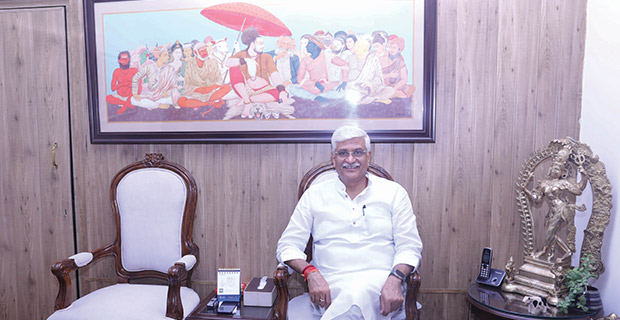
Shri Gajendra Singh Shekhawat, Minister for Culture and Minister for Tourism in the Government of India, speaks on restitution, manuscripts, AI, cultural mapping, tourism, heritage recognition, the Girmitiya legacy and India’s global connections. Some of the most interesting interviews happen when the questionnaire is put aside. This conversation between India Empire Editor-in-Chief Sayantan Chakravarty and Minister Shekhawat was conducted as a free-flowing exchange. One answer led naturally to the next question, taking the discussion from India’s civilisational heritage and the restitution of antiquities to manuscripts, artificial intelligence, cultural mapping, tourism, homestays and UNESCO recognition. It then moved into the story of the Girmitiya community and the Kolkata Memorial, before concluding with India’s long-standing cultural and historical connections with Africa.
You are one of the principal custodians of India’s great civilisational heritage. What are the major steps being taken towards its preservation, and where are the antiquities being brought back from?
The Honourable Prime Minister is the biggest custodian and the person most concerned with preserving our legacy and heritage, both tangible and intangible. Under his leadership, the thrust on cultural heritage has become unprecedented.
It is not only about preservation and conservation, but also about rejuvenating what we have and restoring whatever we have lost or are on the verge of losing. One major thrust has been the restitution of our cultural properties that were taken out of the country through legal or illegal means.
Until 2014, under the prevailing international rules, only 13 antiquities had been brought back to India. But since the Prime Minister himself took interest, and with the bilateral diplomatic relations he has built and the changing stature of India internationally, we have been able to retrieve more than 700 cultural properties.
The number is continuously increasing, and I am sure that by the end of this year it will be in four digits. These antiquities have returned from the United States and almost all the European nations, as well as Australia, New Zealand, Canada and the Central Asian countries. We have been able to bring them back from all these countries.
Another important initiative concerns the conservation and digitisation of India’s written heritage. How are you using technology to make this knowledge accessible to future generations?
In the earlier stages of our civilisation, knowledge was transmitted through Shruti and Smriti. Later, handwritten manuscripts were produced in abundance on palm leaves, the bark of trees, handmade paper, silk and various other media, covering different subjects, languages and scripts.
The Honourable Prime Minister gave us the direction that conservation alone was not enough. Many manuscripts are written in languages and scripts that are not commonly known. Even someone who knows Sanskrit may find it difficult to understand a manuscript because of the handwriting, format and style.
So how does this treasure become useful for the coming generation? How will the next generation know exactly what is written? And this is not merely a treasure for Indians. It is a treasure of humanity. With the help of technology, therefore, we needed to convert these manuscripts into computer-readable language.
We developed our own OCRs (Optical Character Recognition) and LLMs (Large Language Models) backed by artificial intelligence. Scripts written in Sanskrit, Odia, Tamil, Telugu and Kannada can now be read by computers with an accuracy of approximately 90 to 95 per cent. When we began, it was around 40 per cent.
We then launched a programme through an app and appealed across the country to private custodians, institutions, temples, universities, archives, organisations and religious bodies. We created metadata covering 16 points and asked people to photograph their manuscripts and upload the details.
I am very happy and glad to share that, after verification, we have now notified 1 crore 24 lakh manuscripts. We have digitised almost five lakh manuscripts and uploaded them on the website, and we have converted more than a thousand manuscripts into computer-readable format. It is a continuous, ongoing process.
Related News.
-

September 2026 Gorillas Find Names
-

September 2026 India–Kiribati Deepen Cooperation
-

September 2026 India, Ethiopia Deepen Defence Ties
-

September 2026 JAMAICA AT 64,TIES DEEPEN

EDITOR'S DESK, Sep 2026
 Our cover takes us to Volcanoes National Park, where Rwanda recently hosted the 21st Kwita Izina, its annual Gorilla Naming Ceremony. Twenty-two baby mountain gorillas received their names, but the significance of the occasion went far beyond a celebration of wildlife...
more...
Our cover takes us to Volcanoes National Park, where Rwanda recently hosted the 21st Kwita Izina, its annual Gorilla Naming Ceremony. Twenty-two baby mountain gorillas received their names, but the significance of the occasion went far beyond a celebration of wildlife...
more...
Ads Spot

Comments.