

“Rules Being Rewritten”
In his annual message for FY26, Adani Group Chairman Gautam Adani argues that the rules governing economic growth are being rewritten. In a world increasingly shaped by artificial intelligence, energy security and digital transformation, he contends that infrastructure is no longer merely the foundation of growth but an active enabler of intelligence itself. The future, he believes, belongs to those capable of integrating physical assets, digital capability and execution excellence into a single, interconnected system.
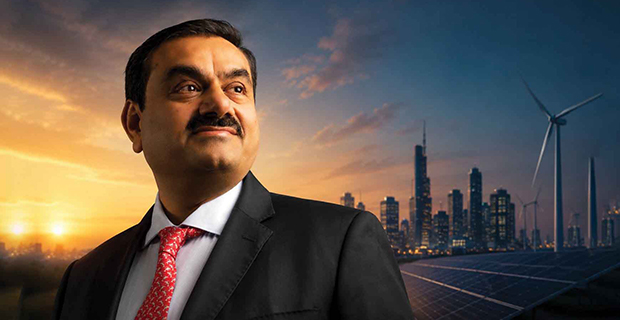
For much of modern economic history, the sequence of development appeared straightforward. Nations built roads, ports, power stations and industrial networks first. Technology arrived later, enhancing the efficiency and productivity of those foundations. According to Adani Group Chairman Gautam Adani, that relationship has now fundamentally changed.
In his annual message for the financial year 2026, Mr Adani presents a vision in which infrastructure and intelligence are no longer separate stages of development but mutually reinforcing forces. Artificial intelligence may dominate global conversations, but before algorithms can analyse data, energy must flow through transmission networks; before digital platforms can connect people and businesses, physical infrastructure must exist to support them.
Viewed through this lens, the Adani Group’s diverse portfolio of businesses acquires a different significance. What may appear to be a collection of independent enterprises spanning ports, airports, renewable energy, power transmission, logistics, manufacturing and data centres is, in reality, part of a larger integrated platform designed to connect the physical and digital economies.
At the heart of Mr Adani’s message lies a central proposition: the next era of global competitiveness will not belong to organisations pursuing isolated opportunities. It will belong to those capable of integrating infrastructure, energy, technology and execution into a unified ecosystem capable of delivering scale, resilience and speed.
Long before artificial intelligence emerged as the defining technology narrative of the decade, the Adani Group had already begun investing in the physical foundations necessary to support a digitally driven future. The group’s FY26 performance figures offer insight into the scale of that ambition.
During the year, the Adani Group invested more than Rs 1.5 lakh crore, representing one of the largest capital deployment programmes undertaken by any corporate entity in India. Renewable energy capacity crossed 19.3 GW following the addition of 5.1 GW during the year, reinforcing the group’s commitment to supporting India’s clean energy transition. Meanwhile, the transmission business expanded its order book to Rs 71,779 crore, reflecting growing demand for robust energy infrastructure.
The group’s logistics and transport businesses also recorded significant milestones. Adani Ports handled more than 500 million tonnes of cargo, strengthening its position as one of the country’s most important gateways for trade and commerce. The greenfield Navi Mumbai International Airport, among India’s largest aviation infrastructure projects, moved closer to becoming a major hub for passenger and cargo connectivity.
Alongside these developments, the group’s data centre business continued progressing towards its long-term goal of establishing a 2 GW platform by 2030. In an era where data processing capability is becoming as strategically important as physical manufacturing capacity, the investment reflects the growing convergence between traditional infrastructure and digital technology.
For Mr Adani, these achievements are not isolated accomplishments. They form part of a deliberate effort to build the backbone of India’s next phase of development. Ports support trade. Airports facilitate mobility. Renewable energy powers industries. Transmission networks ensure reliability. Data centres enable digital transformation. Together, they create an interconnected ecosystem in which each component strengthens the others.
This argument carries particular relevance at a time when governments and corporations around the world are grappling with multiple challenges simultaneously. Energy security concerns, supply-chain disruptions, geopolitical uncertainties and the growing infrastructure requirements of artificial intelligence are reshaping strategic priorities across continents.
According to Mr Adani, the race for technological leadership is increasingly becoming a race for infrastructure readiness. Reliable power supplies, resilient logistics networks, advanced manufacturing capabilities and digital connectivity may prove just as important as technological breakthroughs themselves.
India, he suggests, enters this period with a significant structural advantage. Unlike many mature economies burdened by ageing infrastructure, India retains the ability to build both physical and digital systems simultaneously. Renewable energy, energy storage, logistics networks, ports, airports and data centres can evolve together as integrated systems rather than being retrofitted onto outdated foundations.
The implications extend beyond economics alone. Throughout his message, Mr Adani repeatedly links infrastructure development to broader themes of national resilience, sovereignty and strategic capability. Whether in energy security, defence manufacturing, critical supply chains or digital infrastructure, the underlying principle remains the same: nations that control the foundations of growth will be better positioned to navigate an increasingly uncertain world.
One of the most revealing observations in the Chairman’s message concerns the changing nature of economic constraints. For decades, the principal challenge facing emerging economies was access to capital. Today, Mr Adani argues, the challenge has shifted. The question is no longer whether funding can be secured, but whether projects can be executed rapidly enough to meet rising demand.
This shift reflects growing confidence in India’s economic trajectory while underscoring the importance of execution as a competitive advantage. In a world where capital is increasingly available, the ability to deploy it efficiently, consistently and at scale becomes the defining differentiator.
Ultimately, Mr Adani’s FY26 message is less a review of the past year than a statement about the decade ahead. Infrastructure provides the physical strength of a nation. Intelligence provides the capacity to innovate and adapt. Yet it is the convergence of the two, delivered at unprecedented speed and scale, that will shape the next chapter of global growth.
India, he believes, is uniquely positioned to lead that transformation. The challenge is no longer simply to build more roads, ports, power plants or data centres. It is to create an integrated ecosystem where physical and digital infrastructure work together to support national development, economic resilience and technological leadership.
For Mr Adani, the century ahead will belong to those who recognise that infrastructure and intelligence are no longer separate stories. They are chapters of the same narrative, and together they will determine which nations and enterprises define the future.
Related News.
-

July 2026 Trust Drives Trade
-

July 2026 Unitech Probe Deepens
-

July 2026 Infrastructure Delivers Savings
-

June 2026 FIZZ WARS INTENSIFY

EDITOR'S DESK, Jul 2026
 Every edition of India Empire seeks to capture India’s expanding engagement with the world. This month, that engagement finds its strongest expression in our Cover Story on LAC FIRST, the India-Latin America & Caribbean Business & Diplomatic Conference, recently organised in New Delhi.
more...
Every edition of India Empire seeks to capture India’s expanding engagement with the world. This month, that engagement finds its strongest expression in our Cover Story on LAC FIRST, the India-Latin America & Caribbean Business & Diplomatic Conference, recently organised in New Delhi.
more...
Ads Spot


Comments.