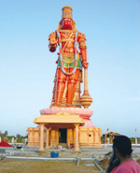
 Thrown into an alien land, Indians in Trinidad held onto their culture to retain their self-dignity. While Indian, especially Hindu, culture has adapted to local mores, it’s surprising how much of the original has stayed intact. When one thinks of the exceptional journey undertaken by Indians in Trinidad & Tobago, it is the manner in which Indians as a whole, against heavy odds, have been able to retain their self-dignity, preserve and enhance their culture, and enrich themselves by a selective engagement with other cultures. The landscapes, art, music, cuisine, and religious edifices and customs of Indians in Trinidad provide an illuminating testimony of the manner in which Indians have been able to inscribe themselves into the psyche of Trinidad. It was all the more imperative, in an alien and hostile land, that Indians be able to inhabit a space which they could claim as their own, and to which they could offer their attachment. Thrown into an alien land, Indians in Trinidad held onto their culture to retain their self-dignity. While Indian, especially Hindu, culture has adapted to local mores, it’s surprising how much of the original has stayed intact. When one thinks of the exceptional journey undertaken by Indians in Trinidad & Tobago, it is the manner in which Indians as a whole, against heavy odds, have been able to retain their self-dignity, preserve and enhance their culture, and enrich themselves by a selective engagement with other cultures. The landscapes, art, music, cuisine, and religious edifices and customs of Indians in Trinidad provide an illuminating testimony of the manner in which Indians have been able to inscribe themselves into the psyche of Trinidad. It was all the more imperative, in an alien and hostile land, that Indians be able to inhabit a space which they could claim as their own, and to which they could offer their attachment.
Those who came from the Gangetic heartland named many of the streets after the principal areas from where they had been recruited, such as Mathura, Kanpur, and Lucknow. Those hailing from Basti in Uttar Pradesh created Basta Hall, while Faizabad became transformed into Fyazabad; indentureds from Barrackpore and Chander Nagar, both in West Bengal, retained these names for the villages in Trinidad to which they were despatched.
In the nineteenth century, the “Hosein” festival, a celebration of Muharram, was the principal festival for both Hindus and Muslims, and the Muharram Massacre of 30 October 1884, in which at least 16 Indians were shot dead by the colonial police, was a desperate attempt by the colonisers to infuse Indians with a distinct and irreconcilable sense of being ‘Muslims’ and ‘Hindus’, besides being a brutal assault on a burgeoning labour movement that paid little attention to religious identities. In other spheres, too, such as the celebration of Divali, Indians in Trinidad have shown an extraordinary pluralism.
 In food and patterns of eating, Indians were to show their capacity for adaptation. Caste distinctions that made impossible commensality in India were, in the conditions of migration, broken down, and vegetarianism was to have little appeal among Indo-Trinidadians. Tandoori cooking remains unknown among Indians in Trinidad and the Caribbean, and curry is made with a curry powder, rather than by mixing a curry paste. In food and patterns of eating, Indians were to show their capacity for adaptation. Caste distinctions that made impossible commensality in India were, in the conditions of migration, broken down, and vegetarianism was to have little appeal among Indo-Trinidadians. Tandoori cooking remains unknown among Indians in Trinidad and the Caribbean, and curry is made with a curry powder, rather than by mixing a curry paste.
In Trinidad, chutney is not only a condiment, but a form of music that Indians have made their own. In music, there appears to have been a divide between Afro-Trinidadian music and Indo-Trinidadian music. Calypso, which occupies the mantle of the ‘national music’, complemented by pan, came to be seen as the exclusive preserve of Afro-Trinidadians, though Drupatee and a few other Indians came to acquire a considerable reputation as calypsonians. Likewise, Indians never made the music of steel bands their own, though today an Indian, Jit Samaroo, is probably the most well-known orchestrator of pan music. But it was in the creation of chutney songs and rhythms that Indians found their own soca or soul music. Taking with easy abandon rhythms from pan and rap, and drawing from the well-springs of Indian folk and even more so film music, Indians evolved a distinct musical form.
Pichakaree is an Indo-Trinidadian musical form which originated in Trinidad and Tobago. Pichakaree songs are generally social commentary, and are sung using a mixture of Hindi, English and Bhojpuri words. The musical form was devised by RaviJi, spiritual leader of the Hindu Prachar Kendra, as an Indo-Trinidadian counterpoint to calypso which often takes a strongly anti-Indian tone. Pichakaree competitions are an integral part of Phagwa celebrations hosted by the Hindu Prachar Kendra.
Indian food taboos and customs remain in some areas, while in others, the food customs are reinterpreted and take new form or are not relevant. A society-wide ethos valorizing generosity with food prevails, especially at ceremonial occasions.
Trinidadian novelist V.S. Naipaul wrote in his travelogue The Middle Passage about Creoles that “Nothing is known about Hinduism or Islam. The Muslim festival of Hosein, with its drum-beating and in the old days stick-fighting is the only festival which is known; Negroes sometimes beat the drums. Indian weddings are also known. There is little interest in the ritual; it is known only that food is given to all comers.” Creole knowledge of Indian rites is now considerable, as is their participation as guests at these events. Food is important in both Hindu and Muslim celebrations.
|